Algorithms and the Limits of Computation
Turing Machine
2026-08-18 21:55
Where we are
What you already have
From Basics of a Turing Machine:
- the 6-tuple \(M = (Q, \Sigma, \Gamma, \delta, q_0, H)\)
- configurations and the yield relation \(\vdash_M\)
- the Universal Turing Machine \(U(\langle M, w \rangle)\)
Every construction there answered how. This unit asks whether.
Two loose threads
Halting. Nothing in the definition forces a machine to stop.
The head moves only where \(\delta\) sends it.
Universality. \(U\) simulates but does not decide.
If \(M\) loops on \(w\), then \(U\) loops too.
What you will be able to do
- Give the formal definition of an algorithm.
- Distinguish Turing-decidable, Turing-semidecidable and Turing-computable.
- State the Church-Turing thesis and say why it is a hypothesis.
- Use a counting argument to show most problems are not even semidecidable.
- Construct a diagonal language and prove no machine semidecides it.
- Prove the Halting Problem unsolvable.
- Use a many-one reduction to transfer unsolvability.
- Decide whether a question about a machine is solvable.
From what machines do, to what they cannot
One big question
Are Turing machines powerful enough to model any conceivable algorithm?
To answer it we must first define algorithm.
The route
- Define algorithm — it turns out to mean halts on every input.
- Count, and find more problems than machines.
- Diagonalize, and name a problem no machine solves.
- Use self-reference to kill the Halting Problem.
- Use reductions to spread unsolvability.
Each technique is sharper than the one before.
What exactly is an algorithm?
The informal definition
An algorithm is an effective, systematic, mechanical method for achieving the desired result for a given problem.
Its properties:
- A finite number of instructions.
- Produces the result in a finite number of steps.
- Can be carried out by a human with only paper and pen.
- Requires no insight, intuition or ingenuity.
Clause 2 is load-bearing
Everything in this unit turns on terminates in finitely many steps.
Two kinds of problem
Decision problems — input \(w\), output yes or no.
Yes means \(w \in L\). Given a chess configuration and it is your turn, can you win?
Function computation — input \(w\), output \(f(w)\).
Given the Facebook graph, what is the minimum number of people between you and your role model?
Decidable, semidecidable, computable
Turing-decidable
\(M\) decides \(L \subseteq \Sigma^*\) iff for all \(w \in \Sigma^*\):
\[\begin{cases} M \text{ accepts } w, & \text{if } w \in L, \\ M \text{ rejects } w, & \text{if } w \notin L. \end{cases}\]
A language is Turing-decidable, or recursive, iff some TM decides it.
Every input gets a verdict. Nothing runs forever.
Turing-computable
\(M\) computes \(f : \Sigma^* \to \Sigma^*\) iff for all \(w \in \Sigma^*\):
\[(q_0, \triangleright w) \vdash^* (q_{\text{acc}}, \triangleright f(w))\]
Again: on every input.
Turing-semidecidable
\(M\) semidecides \(L\) iff for all \(w \in \Sigma^*\):
\[\begin{cases} M \text{ accepts } w, & \text{if } w \in L, \\ M \text{ rejects } w \text{ or runs forever}, & \text{if } w \notin L. \end{cases}\]
A yes answer arrives. A no answer may never arrive.
Which of these is an algorithm?
| Type of computation | Always halt? |
|---|---|
| TM’s for decidable languages | ✓ |
| TM’s for computable functions | ✓ |
| TM’s for semidecidable languages | ✗ |
Algorithm = a TM for a Turing-decidable language, or for a Turing-computable function.
The definitions that follow
- Algorithmic solvability — Turing-decidability or Turing-computability.
- Algorithmic unsolvability — Turing-undecidability or Turing-noncomputability.
Semidecidability is deliberately excluded.
A procedure that might not stop is not an algorithm — however useful it is in practice.
The confusion to avoid
“Semidecidable” does not mean “solvable if you are patient”.
If the machine has not accepted yet, you have learned nothing.
The Church-Turing thesis
The statement
Any algorithm can be executed by a Turing machine.
Equivalently:
- Anything that can be computed can be computed by a Turing machine.
- Turing machines can do anything describable as “purely mechanical”.
Why it cannot be proved
One side is formal — Turing machines.
The other side is informal — what a person or device could mechanically do.
No proof crosses that gap. What supports it is evidence: \(\lambda\)-calculus, register machines, every programming language — all compute the same functions.
Why we care
Without the thesis, “the Halting Problem is undecidable” is a fact about one formalism.
With it, it is a fact about computation.
Two properties of the boundary
If \(L\) is Turing-decidable, then \(\overline{L}\) is Turing-decidable too.
Run the decider and swap the verdict.
If \(L\) is semidecidable and undecidable, then \(\overline{L}\) is not semidecidable.
Otherwise run both machines in parallel and always get an answer — making \(L\) decidable.
Counting machines against problems
The claim
The set of all decision problems is bigger than the set of all Turing machines.
Proved before naming a single unsolvable problem.
Part 1 — problems are uncountable
A decision problem is a function \(\Sigma^* \to \{0,1\}\) — read the answers off as bits.
| Strings | \(\{0,1\}\) | |
|---|---|---|
| \(\epsilon\) | → | 0 |
| 0 | → | 1 |
| 1 | → | 1 |
| 00 | → | 0 |
| 01 | → | 0 |
| 10 | → | 0 |
| 11 | → | 1 |
This one is the number
\[0.0110001\ldots\]
- decision problems \(\leftrightarrow\) reals in \([0,1]\)
- the reals in \([0,1]\) are uncountable
Part 2 — machines are countable
- A TM can be represented as a finite string.
- A finite ASCII string is a binary string.
- The set of all binary strings is countable.
Every program in every language you will ever write is on that list.
The conclusion
An uncountable set cannot inject into a countable one.
Most decision problems are not even Turing-semidecidable.
Diagonalization names a problem
The intuition first
To show a list is incomplete, you do not examine infinitely many entries.
You build one thing the list cannot contain.
How to defeat every entry at once
Build an object that differs from:
- entry 1 in the first place you look
- entry 2 in the second place
- entry \(i\) in the \(i\)th place
Then it cannot equal entry \(i\) for any \(i\).
The cost of defeating all of them is one disagreement each.
Why “diagonalization”
Lay the list out as a grid — machines down, inputs across.
Entry \(i\)’s behaviour is row \(i\). Position \(i\) is column \(i\).
So the places we disagree are the cells \((i,i)\) — the diagonal.
The name is literal.
Step 1 — build the table
| TM | \(w_1\) | \(w_2\) | \(w_3\) | \(w_4\) | \(w_5\) | \(\cdots\) |
|---|---|---|---|---|---|---|
| \(M_1\) | 1 | 0 | 0 | 1 | 0 | \(\cdots\) |
| \(M_2\) | 0 | 0 | 1 | 0 | 0 | \(\cdots\) |
| \(M_3\) | 0 | 1 | 1 | 1 | 1 | \(\cdots\) |
| \(M_4\) | 1 | 1 | 0 | 1 | 0 | \(\cdots\) |
| \(M_5\) | 0 | 1 | 0 | 0 | 0 | \(\cdots\) |
Every semidecidable language is a row, because every machine appears.
Step 2 — read the diagonal, flip it
Diagonal: \(1, 0, 1, 1, 0, \ldots\)
Flipped: \(0, 1, 0, 0, 1, \ldots\)
\[L_d = \{w_i \mid w_i \notin L(M_i)\}, \qquad d_i = \begin{cases} 1 & \text{if } \text{table}_{ii} = 0, \\ 0 & \text{if } \text{table}_{ii} = 1. \end{cases}\]
Step 3 — ask the breaking question
Suppose \(L_d\) is semidecidable. Then \(L_d = L(M_k)\) for some \(M_k\).
Does \(M_k\) accept \(w_k\)?
Case 1 — \(M_k\) accepts \(w_k\)
\[\implies w_k \notin L_d \quad (\text{defn. of } L_d)\]
\[\implies w_k \notin L(M_k) \quad (L_d = L(M_k))\]
\[\implies M_k \text{ does not accept } w_k\]
Contradicts the assumption of this case.
Case 2 — \(M_k\) does not accept \(w_k\)
\[\implies w_k \in L_d \quad (\text{defn. of } L_d)\]
\[\implies w_k \in L(M_k) \quad (L_d = L(M_k))\]
\[\implies M_k \text{ accepts } w_k\]
Contradicts the assumption of this case.
Both branches contradict
\(L_d\) is not Turing-semidecidable.
We have named a specific decision problem no machine solves.
Loops, simulation, and the Halting Problem
Looping needs no complexity
Three machines over \(\Sigma = \{a\}\). Each has one state.
| \(M_1\) | \(\triangleright\) | \(a\) | \(\square\) |
|---|---|---|---|
| \(q_0\) | \((q_0, \rightarrow)\) | \((q_0, \rightarrow)\) | \((q_0, \rightarrow)\) |
The head keeps moving right forever.
Two more that never halt
| \(M_2\) | \(\triangleright\) | \(a\) | \(\square\) |
|---|---|---|---|
| \(q_0\) | \((q_0, \rightarrow)\) | \((q_0, a)\) | \((q_0, \square)\) |
The head does not move; it rewrites the symbol as itself.
| \(M_3\) | \(\triangleright\) | \(a\) | \(\square\) |
|---|---|---|---|
| \(q_0\) | \((q_0, \rightarrow)\) | \((q_0, \leftarrow)\) | \((q_0, \leftarrow)\) |
The head oscillates between the end marker and the first character.
One state each
Non-termination is not the preserve of complicated programs.
Undecidability is not caused by complexity.
SIMULATE is semidecidable
\[L = \{\langle M, w \rangle \mid \text{TM } M \text{ accepts input string } w\}\]
If \(M\) runs forever on \(w\), SIMULATE runs forever. Exactly like \(U\) last unit.
Now assume it always halts
Then invoke PARADOX(<PARADOX>).
The contradiction
Case 1. PARADOX accepts \(\langle\)PARADOX\(\rangle\)
\(\implies\) SIMULATE rejects \(\langle\)PARADOX\(, \langle\)PARADOX\(\rangle\rangle\) \(\implies\) PARADOX rejects \(\langle\)PARADOX\(\rangle\)
Case 2. PARADOX rejects \(\langle\)PARADOX\(\rangle\)
\(\implies\) SIMULATE accepts \(\langle\)PARADOX\(, \langle\)PARADOX\(\rangle\rangle\) \(\implies\) PARADOX accepts \(\langle\)PARADOX\(\rangle\)
SIMULATE is algorithmically impossible.
The same shape, for HALT
\[L = \{\langle M, w \rangle \mid \text{TM } M \text{ halts on input string } w\}\]
Case 1. accepts \(\implies\) HALT rejects \(\implies\) runs forever.
Case 2. runs forever \(\implies\) HALT accepts \(\implies\) accepts.
Both constructions, side by side
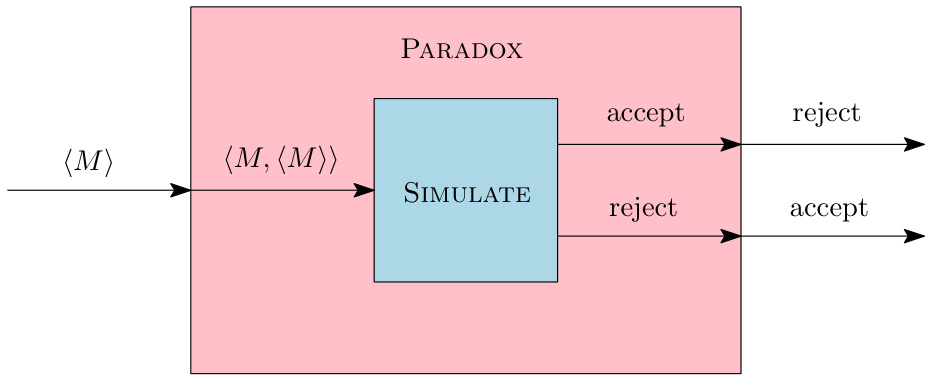
SIMULATE.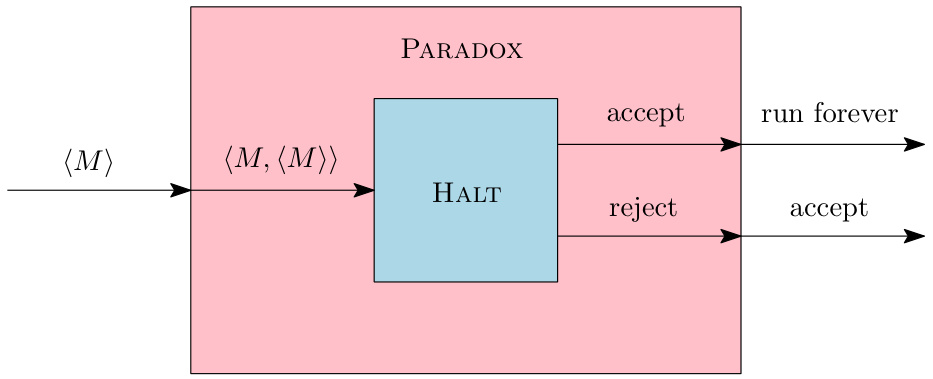
HALT.Only the middle box and one output label change.
What this rules out
No perfect infinite-loop detector.
No perfect static analyser for arbitrary runtime behaviour.
Ever, in any language.
Reductions spread unsolvability
Diagonalization once, then reduce
\[L_{\text{old}} \leq_m L_{\text{new}}\]
if there is a computable \(f\) with
\[x \in L_{\text{old}} \iff f(x) \in L_{\text{new}}\]
The picture
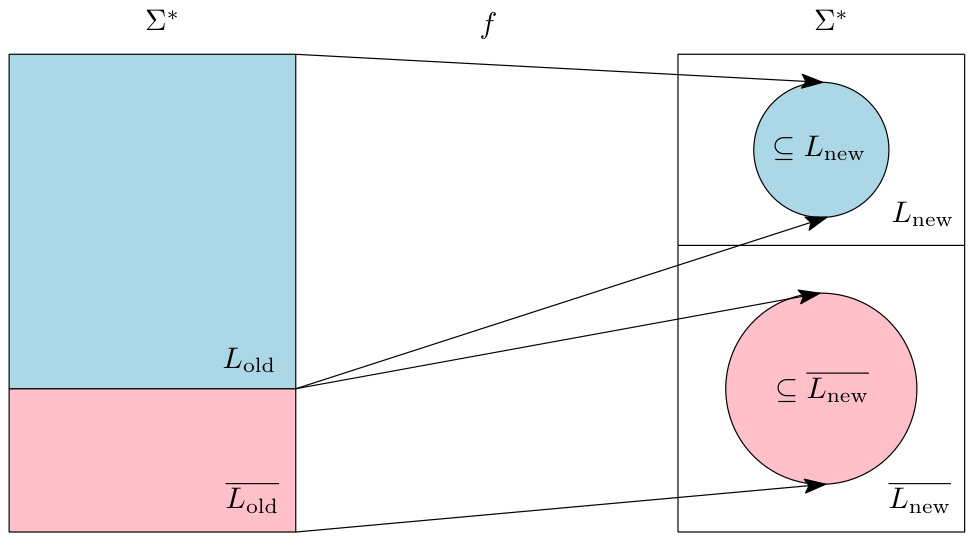
Yes-instances land in \(L_{\text{new}}\); no-instances land in its complement.
The \(m\) stands for many-to-one.
The consequences
If \(L_{\text{old}} \leq_m L_{\text{new}}\):
- if \(L_{\text{old}}\) is undecidable, so is \(L_{\text{new}}\)
- if \(L_{\text{old}}\) is not semidecidable, neither is \(L_{\text{new}}\)
- if \(L_{\text{new}}\) is decidable, so is \(L_{\text{old}}\)
HALT again, by reduction
Assume HALT is algorithmically possible. Then build:
Line 2 is what makes it terminate.
Therefore
If HALT is an algorithm, so is SIMULATE.
But SIMULATE is impossible.
So HALT is impossible.
Direction is everything
We reduce the known-hard problem to the new problem.
The reverse proves nothing — it says the new problem is no harder than something impossible.
To check yourself: write out the imagined decider and see which problem it decides.
Which questions about machines are solvable?
Algorithmically solvable
- Does \(M\) have at least 481 states?
- Does \(M\) take more than 481 steps on input \(\epsilon\)?
- Does \(M\) take more than 481 steps on some input?
- Does \(M\) take more than 481 steps on all inputs?
- Does \(M\) ever move its head more than 481 cells from the left endmarker on \(\epsilon\)?
They all share a bound.
Why a bound decides it
“More than 481 steps on \(\epsilon\)?”
Simulate for 482 steps and look.
That simulation always halts — the step count is fixed in advance.
Algorithmically unsolvable
- Given \(M\) and \(w\), is \(w \in L(M)\)?
- Is \(L(M)\) nonempty?
- Is \(L(M) = \Sigma^*\)?
- Is \(L(M_1) = L(M_2)\)?
- Is \(L(M_1) \subseteq L(M_2)\)?
- Is \(L(M_1) \cap L(M_2)\) nonempty?
- Given \(M\) and \(w\), does \(M\) use a finite amount of tape?
They all quantify over all inputs.
The move to practise
Given a new question, ask: could a finite amount of simulation settle it?
- Yes → probably decidable. Say how much simulation.
- No → look for the reduction. Remember the direction.
The pattern
Anything a finite check settles is decidable.
Anything requiring behaviour on all inputs generally is not.
Summary
Four techniques, in order
- Counting proves unsolvable problems exist without naming one.
- Diagonalization names one.
- Self-reference reaches the problem people care about.
- Reduction turns one result into unlimited results.
Reduction is the one you will actually use.
What you can now do
- Define an algorithm as a machine that halts on every input.
- Place a problem as decidable, semidecidable, or neither.
- State the Church-Turing thesis and say why it is a hypothesis.
- Prove by counting that most problems are not semidecidable.
- Construct \(L_d\) and derive the contradiction.
- Prove
SIMULATEandHALTimpossible by self-reference. - Write a reduction in the correct direction.
- Sort questions about machines as bounded or behavioural.
The limit is not the machine’s
The previous unit built a model of computation and found it strong enough to do anything a computer can.
This unit found its edge.
By the Church-Turing thesis, that edge is the limit of computation — no faster hardware and no better language moves it.
What real tools do about it
Every question about arbitrary program behaviour is undecidable in general.
Real tools work because they give up something:
- they approximate
- they restrict the language
- they answer “don’t know”
Knowing which of the three a tool has chosen is the useful form of everything proved here.
Turing Machine · Algorithms and the Limits of Computation