Higher-Order Functions: Lambdas as Parameters and Return Values
Kotlin
2026-08-21 09:00
Where we are
From using to writing
Programming with Lambdas taught you to use filter and map.
This unit is about writing them.
And about the cost
In Java, every lambda is an object, and calling it is an indirection.
In a hot loop, that is a real reason to write the imperative version.
Kotlin’s answer
inline — and it is more thorough than it sounds.
The compiler substitutes the function’s body and the lambda’s body.
No object. No call. Nothing left of the abstraction.
What you will be able to do
- Write function types.
- Declare and call higher-order functions.
- Default or nullable function parameters.
- Return functions from functions.
- Remove duplication with a lambda parameter.
- Explain what
inlinedoes. - Judge when to inline.
- Use
useandwithLock. - Control returns from lambdas.
Function types
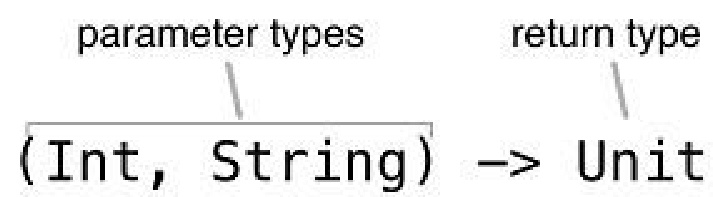
The syntax
Writing them down
The return type is always written, even when it is Unit.
The arrow needs something after it.
Nullable, with care
Without the outer parentheses, the ? attaches to the return type.
How this differs from unit 5
There: a SAM conversion into a Java interface instance.
Here: a proper type. No conversion happens or is needed.
Underneath it compiles to Function1 — so Java can still call it.
Taking functions as parameters
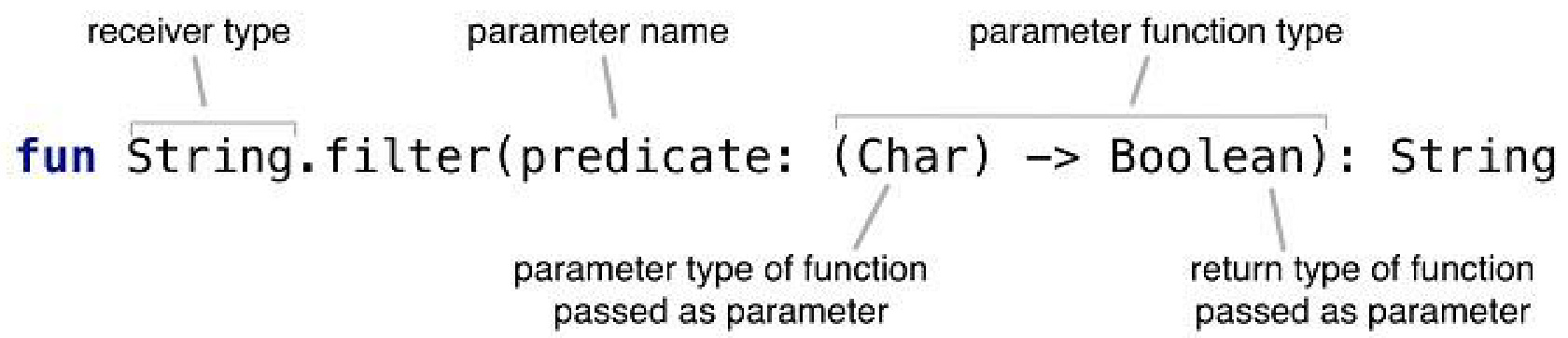
The declaration
Calling it
Name the parameters inside the type
The IDE shows those names at the call site.
Real documentation for whoever writes the lambda.
Write filter yourself
Doing this once changes how the standard library reads.
Optional: a default value
Optional: a nullable type
Which to use
Default value, usually. The caller sees a working default; the body has no null handling.
Nullable, when absence is genuinely meaningful.
Note the name invoke
Another convention, from unit 7.
Calling a value with parentheses means calling its invoke.
Which is why ?.invoke() is the safe-call form.
Returning functions
Built from runtime state
The returned lambda captures the enclosing parameters.
The persuasive example
Compare with the alternative
By hand: a chain of ifs inside the filtering loop.
Re-evaluated per element.
Composing a function moves the logic to one place.
Removing duplication
Three near-identical functions
Average duration for Windows users.
Then for Mac users.
Then filtered by page.
One
fun List<SiteVisit>.averageDurationFor(predicate: (SiteVisit) -> Boolean) =
    filter(predicate).map(SiteVisit::duration).average()

log.averageDurationFor { it.os == OS.WINDOWS }
log.averageDurationFor { it.os in setOf(OS.ANDROID, OS.IOS) }
log.averageDurationFor { it.os == OS.IOS && it.path == "/signup" }
Why a lambda rather than a class
Java’s answer: a strategy interface with an implementation per case.
Several files for what is here one parameter.
And the caller writes the behaviour inline, where a reader can see it.
The general lesson
In Kotlin, “extract the difference” often means extracting a function.
In Java it would mean extracting a type.
Inline functions
What inline does
The call site
No object anywhere.
Where it does not apply
If a lambda parameter is stored or passed on,
its body cannot be substituted — something is holding it.
noinline exempts that parameter; the rest still inlines.
When to use it
Small functions taking lambdas — which is why filter costs no more than a loop.
Not large bodies — the body is copied into every call site.
Two different optimisations
inline removes the lambda overhead.
It does not remove the intermediate collections.
That is what sequences were for. Different costs, different tools.
Resource management
The pattern
Acquire, run, release in a finally.
Java added syntax
try-with-resources — a language feature, in the compiler.
Kotlin needs none. use is an ordinary extension function.
And it costs nothing
Because it is inline.
Without that, every use would allocate.
Free higher-order functions are what let a library do a language’s job.
Note that return
The return inside the use block
returns from readFirstLineFromFile, not from the lambda.
Which is the next section — and only possible because use is inline.
Returns from lambdas
Non-local return
Which is what you want
forEach with a return behaves exactly like a for loop with a return.
That is what makes the functional version a genuine replacement.
Why only when inlined
The lambda’s body has been compiled into the enclosing function.
So the return is an ordinary return from that function.
A non-inlined lambda lives in a separate object. The compiler forbids it.
Labels

Returning from the lambda alone
The lambda’s equivalent of continue.
Anonymous functions
One rule resolves all three
returnreturns from the nearest enclosing function declared withfun.
In a lambda, that is the outer function.
In an anonymous function, it is the anonymous function.
Which to choose
Lambdas for nearly everything. They read better.
An anonymous function when several returns would each need a label.
Summary
The six things to carry away
- Higher-order functions are free, and that changes what a library can do.
- Which is why
useis a function where Java needed syntax. - Write
filteronce and the standard library stops being magic. - Extract a function where Java would extract a type.
- A default lambda beats a nullable function parameter most of the time.
- Non-local return is a consequence of inlining, not a rule.
Where next
Generics — type parameters, constraints, and erasure.
Kotlin’s answer to erasure is reified type parameters.
Which work only because of inlining. One more thing this unit paid for in advance.
Kotlin · Higher-Order Functions: Lambdas as Parameters and Return Values