Operator Overloading and Other Conventions
Kotlin
2026-08-21 09:00
Where we are
Two loose ends
Unit 2: in tested membership and drove for loops.
Unit 3: 1 to "one" was a function, not syntax.
They are the same thing.
Conventions
Certain language constructs are defined as calls to functions
with specific names.
Define such a function on your type, and the syntax works for it.
What you will be able to do
- Explain the convention principle.
- Overload arithmetic operators.
- Choose between
plusandplusAssign. - Implement
equalsandcompareTo. - Implement
get,set,contains,rangeTo,iterator. - Use destructuring and explain
componentN. - Use delegated properties.
- Implement your own delegate.
- Use map-backed and framework delegates.
Why not interfaces
Java: to be iterable, implement Iterable.
Kotlin: define a function named iterator.
Which can be an extension — so a class you do not own becomes iterable.
Between Java and Scala
Java — operators on built-in types only.
Scala — arbitrary new operators, and libraries nobody can read.
Kotlin — a fixed set of operators, and you decide what each means.
Arithmetic operators
plus

Defining one
Why operator is required
It prevents a function that happens to be named plus
from accidentally gaining operator syntax.
And it tells a reader that operator use is intended.
Three extensions of the idea
Note: p * 1.5 works. 1.5 * p does not, unless you define that too.
Unary

The set
unaryPlus · unaryMinus · not · inc · dec
Arguably more readable, and no precedence surprises.
Compound assignment
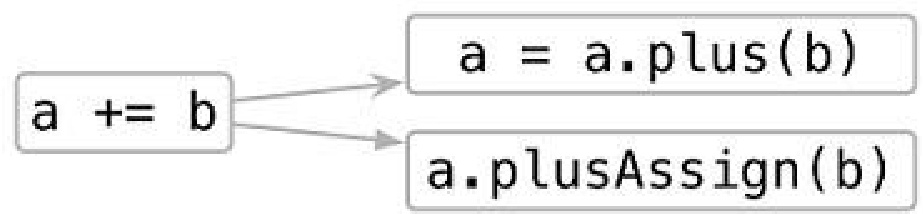
Two possible meanings
plus — new object, reassign. Requires a var.
plusAssign — modify in place, return Unit. Works on a val.
Define one, never both
With both, += is ambiguous and the compiler reports an error.
The standard library’s convention
Read-only collections define plus — a new collection.
Mutable ones define plusAssign — modified in place.
Which operator is available tells you which kind you have.
Comparison operators
== calls equals
So it compares contents. Reference comparison is ===.
The opposite of Java, and the better way round —
content comparison is what you want, so it gets the shorter syntax.
And it checks null first
In Java, a.equals(b) throws when a is null.
Which is why defensive Java puts the constant first.
Two implementation notes
equals is marked override, not operator — it is already marked in Any.
And it cannot be an extension: the inherited member would always win.
Unit 3’s dispatch rule, showing its consequences.
compareTo

All four from one function
Plus sorting, max and min from the standard library.
A performance note
The field-by-field version is faster than compareValuesBy.
Write the readable form. Optimise if a profiler says to.
Collection conventions
get

set

Not just integers
A map’s get takes a key. Yours can take whatever suits.
Multiple parameters too: matrix[row, col].
in

Reads as you would say it
rangeTo
Any Comparable gets one free — so compareTo already earned you this.
iterator
LocalDate is a JDK class. That extension makes it loop-able.
Now unit 2 makes sense
for (c in "abc") — CharSequence has an iterator extension.
c in 'a'..'z' — .. built a range, in called its contains.
One keyword, two functions.
And they can all be extensions
Java ties this to implementing interfaces.
You cannot make somebody else’s class implement your interface.
Kotlin can give a library class indexing, iteration and ranges without touching it.
Destructuring
The convention

Data classes generate them
One more item on the data list, alongside equals, hashCode, toString, copy.
Returning two values
A real improvement on an out-parameter or an array.
In loops
Which is what map iteration was doing all along.
Map.Entry has component1 and component2 extensions.
The limitation
Destructuring is positional, not by name.
Reorder a data class’s constructor and every destructuring silently changes meaning.
Still compiles. Values now wrong.
Delegated properties
The idea
A property does not have to store its value in a field.
With by, its accessors are someone else’s job.
by lazy
What you got
Runs on first access. Result cached.
Thread-safe by default.
No nullable field, no !!.
Delegates.observable
The notification logic exists in exactly one place.
A third observable property is one line.
Implementing your own
class ObservableProperty(var propValue: Int, ...) {
    operator fun getValue(p: Person, prop: KProperty<*>): Int = propValue

    operator fun setValue(p: Person, prop: KProperty<*>, newValue: Int) {
        val oldValue = propValue
        propValue = newValue
        changeSupport.firePropertyChange(prop.name, oldValue, newValue)
    }
}
The KProperty parameter matters
It lets a delegate behave differently per property.
By using the property’s name as a key.
Which is what the map-backed case relies on entirely.
The translation rule

That is the whole mechanism
A hidden field holding the delegate.
A getter calling getValue. A setter calling setValue.
Any delegate you meet, however clever, is doing only this.
A map as a delegate
Fixed and dynamic attributes, accessed identically.
In frameworks
The class reads like a plain object. The delegate does the database work.
Summary
The six things to carry away
- Kotlin ties syntax to function names, not interfaces — so conventions can be extensions.
- The operator set is fixed; only the meanings are yours.
==callsequalsand checks null first, which removes a Java bug class.- Two loose ends closed:
inwas two functions;towas an infix extension. - Destructuring is positional, and reordering a data class is a real hazard.
- Delegated properties have one translation rule and unlimited reach.
Where next
Higher-Order Functions returns to the functional thread.
Unit 5 taught you to use lambdas.
This one is about writing functions that take and return them — and inline.
Kotlin · Operator Overloading and Other Conventions