Defining and Calling Functions
Kotlin
2026-08-21 09:00
Where we are
From declaring to calling
Kotlin Basics taught the syntax for declaring things.
This unit is about the calling side.
And about a feature with no Java equivalent at all.
One running example
joinToString — a collection, a separator, a prefix, a postfix.
Written and rewritten as each feature arrives.
By the end: a one-line call available on every collection.
What you will be able to do
- Create collections and say what they are.
- Use named arguments.
- Give parameters default values.
- Declare top-level functions and properties.
- Write extension functions.
- Explain extension dispatch.
- Declare extension properties.
- Use
varargand the spread operator. - Use infix calls and destructuring.
- Use the string extensions and triple-quoted strings.
- Extract local functions.
The question this unit answers
Unit 1 committed Kotlin to full interoperability.
This is where that commitment first costs something —
and where the payment turns out to be interesting.
What Kotlin collections really are
Creating them
Note the to. It looks like syntax. Hold that thought.
Now ask what they are
Kotlin has no collection classes of its own.
Why
A Kotlin list passed to a Java method needs no conversion.
Because it is a Java list.
No adapter, no copy, no surprise.
But Java’s API is thin
Neither exists on java.util.List or java.util.Set.
So how?
Kotlin cannot modify Java’s classes — they ship in the JDK.
Cannot subclass them — listOf returns the real thing.
Will not wrap them — that defeats the point.
Named arguments
The obvious version
Three strings in a row. Which is which?
Name them
Checked by the compiler.
Name one, and every later one must be named too.
The limitation
Named arguments do not work on Java methods.
Java bytecode does not reliably preserve parameter names.
The IDE may show them. The compiler cannot verify them.
Default parameter values
Declare the defaults
Where the two features compose
Positional arguments → omit only from the end.
Named arguments → omit any subset, in any order.
Java’s overload family cannot do that
You would need one overload per combination.
For Java callers who need them: @JvmOverloads generates them.
Top-level functions and properties
Where should joinToString live?
It belongs to no object.
In Java: a class that exists only as a container, modelling nothing.
Kotlin: nowhere in particular
No class. No instance. No static.
What the compiler does
join.kt → a class named JoinKt, with static methods.
Java sees exactly the utility class it expects.
@file:JvmName("StringFunctions") renames it.
Top-level properties
const matters at the boundary: Java sees a field, not a method.
The recurring move
A cleaner Kotlin model.
Whatever Java expects, generated underneath.
Extension functions
The central idea
Receiver type, receiver object

this may be omitted
How it actually works
A static function whose first parameter is the receiver.
No modification, no patching, no proxy.
Two consequences, immediately
Java can call it. It is a static method. Extensions are interoperable by construction.
It cannot see private members. An outsider with pleasant syntax.
Which is what makes extending types you do not own safe.
Imports
A feature, not an inconvenience: nobody’s extension can silently change your code.
No overriding
Declared outside, resolved statically
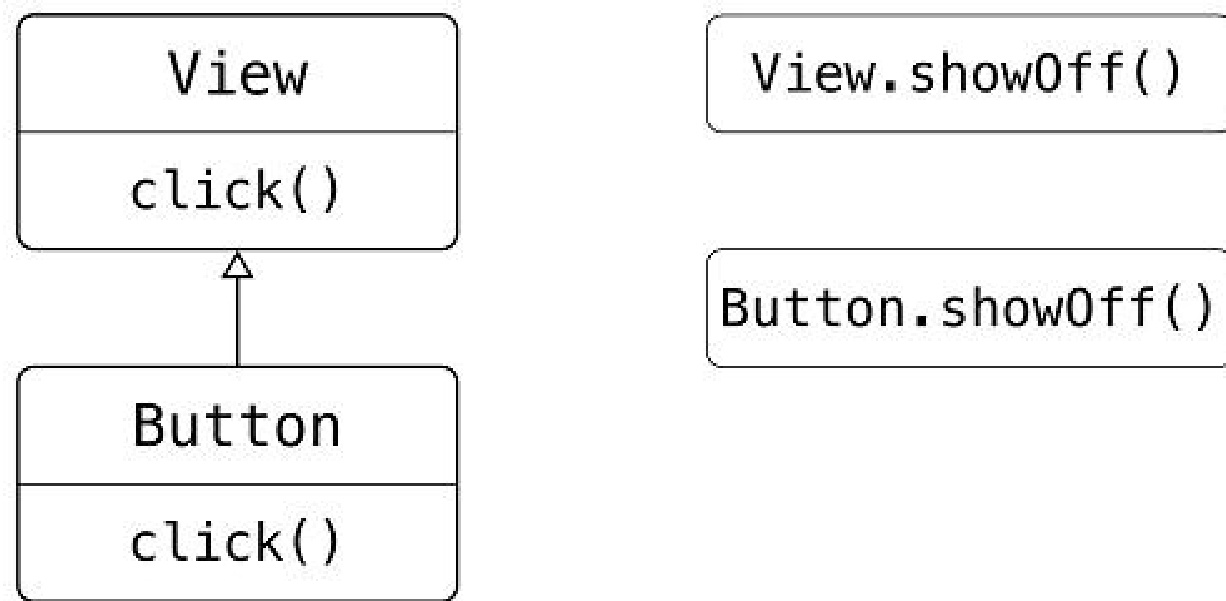
And a member always wins
If a class later adds a matching method, it takes over — silently.
Not a defect. Static functions have never been polymorphic.
Good reason not to write an extension a class ought to have as a member.
Extension properties
Must have a custom getter — there is nowhere to put a field.
Always computed, never held.
Now the question is answered
Every one an extension function on a Java interface.
The collection API you use every day is a library of extensions.
Varargs, infix, destructuring
vararg
Why the * is required
In Java, “one array” or “these elements” depends on context.
A known source of quiet bugs.
Kotlin makes the intent explicit — and lets you mix spread with fixed elements.
infix
to is not syntax
An extension function on Any, marked infix, returning a Pair.
So mapOf(1 to "one") is a function call taking varargs of Pair.
Something that looks like language support is a library.
Destructuring
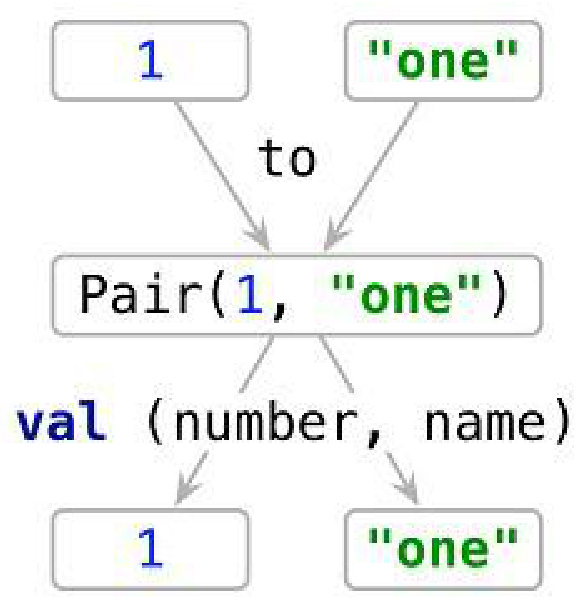
And it was in unit 2 already
Itself a convention, backed by component1() and component2().
Explained properly in unit 7.
Strings and regular expressions
A genuinely bad Java API
split takes a regular expression. . matches anything.
The signature gives no hint. The failure is silent.
Kotlin’s fix is in the types
A String argument means a literal delimiter. No accidents.
Parsing without a regex
More readable, easier to debug. A regex is not always the right tool.
With one, and no backslash soup
Triple-quoted strings take no escape sequences.
And destructured is the feature from two sections ago, doing real work.
Multiline
Indent the literal to match the code; the indentation does not reach the output.
Local functions
The problem
The same shape twice. With a third field it would be three.
The unsatisfactory fix
Extract a private method.
Removes the duplication.
Adds a method to the class that nothing else should call.
Nest it instead
Then tidy with an extension
Why this closes the unit
All these features answer one question:
Where should this code live, so it is easy to call and easy to read?
Java answers “inside a class” every time. Kotlin usually does not.
Summary
The six things to carry away
- Kotlin’s collections are Java’s collections.
- An extension is a static function with a receiver — and everything follows from that.
- The entire collection API is a library of extensions.
- Named arguments plus defaults do what an overload family cannot.
tois a function, not syntax. Map literals are function calls.- The real question is where code should live, and it is not always inside a class.
Where next
Classes, Objects, and Interfaces turns to declarations.
Interfaces with defaults, open/final/abstract, constructors, data classes, delegation, and object.
Where you find out how much of a Java class the compiler will write for you.
Kotlin · Defining and Calling Functions