Kotlin: What and Why
Kotlin
2026-08-21 09:00
Where we are
The first question
The JVM already had Java.
And Groovy, Scala, Clojure, JRuby, Jython.
So why another one?
Kotlin’s pitch is modest
No new computational model.
No abandoning your libraries.
No abandoning your existing code.
The claim is a conjunction
statically typed · concise · safe · interoperable
Each on its own is unremarkable.
All four at once is the whole argument.
What you will be able to do
- Read a short Kotlin program and name what makes it short.
- State Kotlin’s primary traits.
- Explain static typing with inference.
- Describe the functional side and its benefits.
- Place Kotlin in its application areas.
- State the four design commitments.
- Describe how Kotlin is compiled.
One thread to watch
Nearly every design decision traces back to interoperability.
Kotlin could have been safer, more concise, more purely functional —
if it were willing to break from Java. It is not.
A first taste
Nine lines
The oldest is: Person(name=Bob, age=29)The Java equivalent
Several dozen lines.
Most of it mechanical.
What is doing the work
- data class —
equals,hashCode,toStringgenerated - default parameter value —
agedefaults to null - type inference —
List<Person>never written down - lambda — a function passed as a value
- Elvis operator —
?:supplies a fallback - string template —
$oldestin the string
And in the type itself
Enforced by the compiler.
The single feature Kotlin is best known for.
Do not master this yet
Its purpose is to make later units read as explanations
rather than a list of features arriving from nowhere.
But register two things
No boilerplate. No getters, no constructor body, no equals.
The query describes the result, rather than a procedure for getting it.
Statically typed without the noise
Every type is known
Like Java. Unlike Groovy or JRuby.
The compiler verifies that what you call actually exists.
You just do not write it
Every one is as strongly typed as a declaration with the type spelled out.
What static typing buys
- performance — no runtime method resolution
- reliability — the compiler checks consistency
- maintainability — you can see what things are
- tool support — refactoring, completion, navigation
What it usually costs
The same thing, said twice, and neither half optional.
The pattern to notice
Kotlin does not remove a guarantee to gain convenience.
It keeps the guarantee and removes the ceremony.
Watch for it in nullability, smart casts, data classes, delegated properties.
Functional and object-oriented
Not a compromise position
Classes, interfaces, inheritance — all still there.
Plus a full functional capability.
You choose per problem, not per language.
Three ingredients
- First-class functions — functions are values
- Immutability — objects that cannot change
- No side effects — same inputs, same result, nothing touched
Three benefits
Conciseness — a function-as-value replaces a block of code.
Safe multithreading — immutable data cannot be corrupted by concurrent access.
Easier testing — no setup, no mocks. Call it, check the result.
The middle one is the strong claim
Not “helps you manage synchronisation bugs”.
Eliminates the category. There is nothing to corrupt.
Where Kotlin is used
Server-side
Web applications, backends, microservices.
Not because Kotlin is better at HTTP.
Because it uses every Java framework unchanged, one file at a time.
Android
Where the benefits concentrate.
Many small screens → boilerplate matters.
A NullPointerException → a crash the user sees.
And a preview
Look twice
Both look like new syntax.
Neither is.
Ordinary Kotlin — functions, lambdas, operator conventions.
Notice what the first one does
A for loop inside markup.
Type-checked. Completed by the IDE.
No template engine can offer that.
The philosophy
Four commitments
Pragmatic · Concise · Safe · Interoperable
Between them they explain nearly every design decision.
Pragmatic
A practical language for real problems.
Not a research vehicle. Features mostly proven elsewhere.
And no imposed architecture.
Concise
Reading takes longer than writing.
So remove the ceremony, and the reader sees intent.
But not cryptic operators. Short is not the goal; clear is.
Safe — nullability
The most common runtime failure on the JVM —
converted into a compile error.
Safe — smart casts
Java requires the check and the cast. The same fact, twice.
Same principle as type inference, applied to control flow.
Interoperable
Kotlin calls Java. Java calls Kotlin.
Kotlin’s collections are Java collections.
Which is the only way a language ever gets adopted at all.
What this commitment costs
Bills that come due later in the module:
- platform types — Java carries no nullability information
- collection mutability — read-only views Java can still modify
Both compromises. Both more instructive than the clean design.
From source to bytecode
The pipeline
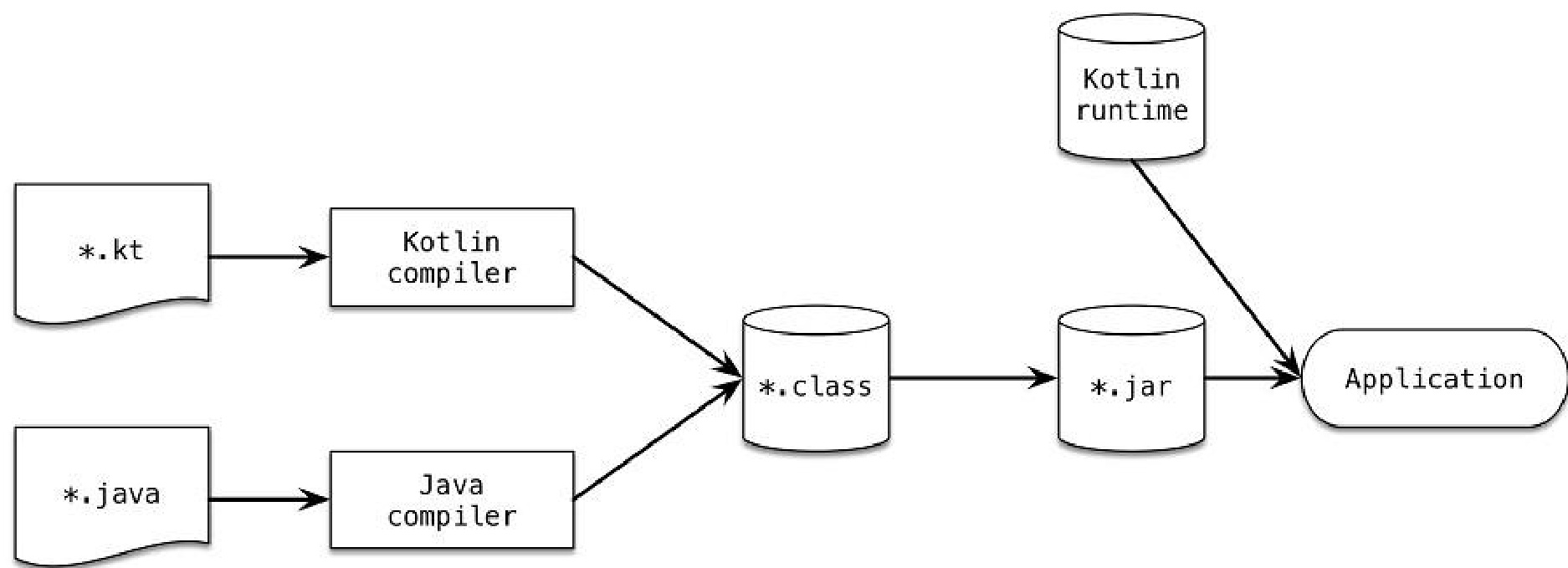
By hand, once
kotlinc hello.kt -include-runtime -d hello.jar
java -jar hello.jar
In practice: Gradle, Maven, or the IDE.
Plus the Kotlin runtime library — small, shipped with the application.
Why this justifies the claim
Kotlin produces the same artefacts Java does. Therefore:
- Java libraries work without adaptation
- Java calls Kotlin classes as Java classes
- a
.ktfile compiles alongside a Java project - profilers, debuggers, build systems keep working
Not aspirational
The interoperability commitment
falls out of the compilation model.
Summary
What you can now recognise
A short program and what makes it short.
The traits, the philosophy, the toolchain.
Nothing explained fully. Everything returns.
The six things to carry away
- The claim is a conjunction — four properties at once, not one feature.
- Static typing survives having almost no annotations. Guarantee kept, ceremony dropped.
- Functional and object-oriented, so you choose per problem.
- Safety means the type system —
StringandString?are different types. - Interoperability explains the compromises as well as the strengths.
- The DSL examples are ordinary Kotlin. That is where this module ends up.
Where next
Kotlin Basics stops surveying and starts teaching.
Functions and variables, classes and properties, when, smart casts, loops, exceptions.
By the end you write small programs instead of only reading them.
Kotlin · Kotlin: What and Why