DSL Construction
Kotlin
2026-08-21 09:00
Where we are
The last unit builds nothing new
Extension functions and infix calls — unit 3.
Lambdas — unit 5. Operator conventions — unit 7. Higher-order functions — unit 8.
It assembles.
The contrast with last unit
Reflection achieved flexibility at runtime, giving up static checking.
DSLs achieve expressiveness at compile time, keeping every guarantee.
A taste of the goal
None is a string. None is parsed at runtime.
Each is ordinary Kotlin, type-checked, with IDE completion.
What you will be able to do
- Define a DSL and distinguish internal from external.
- Explain what gives a DSL structure.
- Use a lambda with a receiver.
- Build a nested DSL.
- Use the
invokeconvention. - Combine infix, extensions and member extensions.
- Read real Kotlin DSLs.
- Judge when a DSL is warranted.
The honest caveat, up front
A DSL is a vocabulary readers must learn.
Sometimes an excellent bargain.
Sometimes a plain function would have been kinder.
From APIs to DSLs
What a DSL is
A general-purpose language does everything adequately.
A domain-specific one does one thing well, giving up generality.
SQL. Regular expressions.
Declarative
Describe what the result is, not how to get it.
Which is where the concision comes from —
and why a SQL engine can reorder your query.
External DSLs
The compiler cannot check a string.
The IDE cannot complete it. Refactoring cannot rename through it.
Internal DSLs
The same query, checked, completed, safely refactored.
What actually makes it a DSL
Clean API design gives readable calls.
A DSL gives structure — a grammar.
Flat versus nested
Command-query API — each call stands alone. A flat sequence.
Structured DSL — calls nest and chain.
Which is why an HTML DSL looks like HTML.
And nesting is the mechanism
Which is why the next section
is the central one in the unit.
Lambdas with receivers
The type
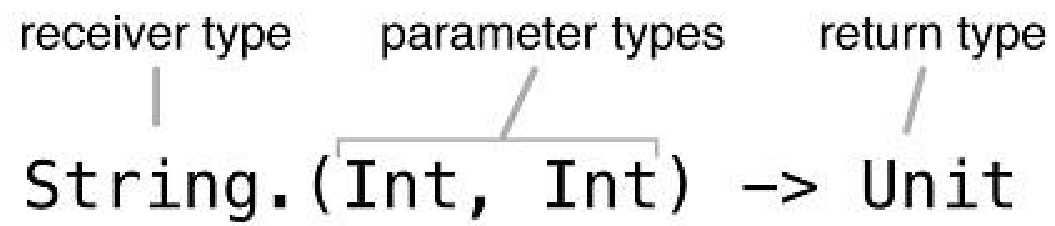
Small difference, large effect
Nested several levels deep, that is the difference between a DSL
and a pile of punctuation.
You have already used these
apply, with, run — all of them.
Go back and look at apply
It stops looking like a special form.
It becomes an ordinary function you could have written.
The HTML builder
Inside tr { }, this is a TR.
So only the functions declared on TR are available.
Two things at once
Nesting — from lambdas containing other calls.
Static checking — from the receiver type controlling what is legal inside.
Misplacing a tag is a compile error
Not something a string template can offer at any price.
Nor achievable by naming discipline. It falls out of the receiver types.
Member extensions
The vocabulary is available inside the block and invisible outside it.
Which is the whole technique
Receiver-scoped vocabulary.
Statically checked nesting.
The invoke convention
Making an object callable
Unit 7’s convention mechanism, applied to the call syntax.
You have seen it already
Function types are interfaces with an invoke method.
Which is why a lambda in a variable can be called with parentheses.
And why unit 8’s nullable function parameter needed ?.invoke().
Why a DSL wants it
Both, from one object.
The implementation
The general shape
invoke loosens the nesting requirement.
A block form for many items, a direct form for one —
without duplicating the API.
A caution
invoke on an arbitrary class makes calls unreadable.
person("Alice") tells the reader nothing.
It earns its place in a DSL, where structure supplies the meaning.
DSLs in practice
A reading exercise
The mechanisms are known.
The work is recognising them in the wild.
Testing frameworks
An infix function combined with an extension.
Date arithmetic
Extension properties — doing something a subclass could not. You cannot subclass Int.
SQL with Exposed
Three mechanisms stacked
Member extensions — autoIncrement() exists only inside a Table.
Infix functions — eq, less, like.
Lambdas with receivers — the query block.
And it is statically typed
A renamed column is a compile error.
Not a broken query discovered in production.
What to take from this
Every one is ordinary Kotlin.
No macro system. No metaprogramming. No runtime parsing.
A small set of features composing into what looks like language design.
When a DSL is warranted
The costs are real
A vocabulary readers must learn.
Indirection between what is written and what happens.
The standing temptation to be clever.
The benefit is real too
In a domain that is repetitive and genuinely has structure.
Markup. Queries. Builds. Tests. UI layout.
The honest test
Does the DSL make the reader’s job easier?
A DSL that is delightful to write and puzzling to read has failed,
however pleased its author was.
The rule of thumb
A handful of calls → write the functions.
A hundred structurally similar ones → build the DSL.
Closing the module
Look at what this unit used
Extensions and infix — unit 3.
Lambdas — unit 5. Conventions — unit 7. Higher-order functions — unit 8.
None of them was introduced for DSLs.
The argument the module has been making
Kotlin’s power is not in any individual feature — most are small —
but in how cleanly they compose.
And it generalises
A language of small, orthogonal, well-chosen features
lets its users build things its designers never specified.
That is a claim about language design, not just about Kotlin.
Summary
The seven things to carry away
- A DSL is not a tidy API; it is a grammar.
- Internal DSLs keep everything a string loses.
T.() -> Unitis the mechanism — andapplywas using it all along.- Misplacing a tag is a compile error, because receiver types control what is legal.
- Member extensions confine the vocabulary to the block.
invokeis unit 7’s convention applied to the call itself.- The honest test is whether the reader’s job got easier.
And the module’s claim
Small features that compose
beat big features that do not.
Kotlin · DSL Construction