The Limits of Computation
Computation and Turing Machines · v1.0.1
2026-09-07 02:23:35
Where we are
Where this fits
- The previous unit named the answer to Hilbert’s Entscheidungsproblem: No
- Not every logical assertion is mechanically decidable
- That answer was stated without justification
- This unit builds the vocabulary the justification depends on
Outline of key topics
- Problems, instances, and the decision problem
- An informal notion of decidability
- Formalizing a decision problem in predicate logic
- The negative answer, with two examples
- What a proof of undecidability requires
Problems, instances, and decision problems
Problem versus instance
Problem. MULT
Given two numbers \(x\) and \(y\), what is \(x \times y\)?
Instance. One case of MULT
\(67 \times 4.5 = 301.5\)
An algorithm answers every instance. One instance answers nothing about the problem.
The decision problem, as a function
A decision problem restricts the output to True or False.
\[P : \text{instance} \to \{\text{True}, \text{False}\}\]
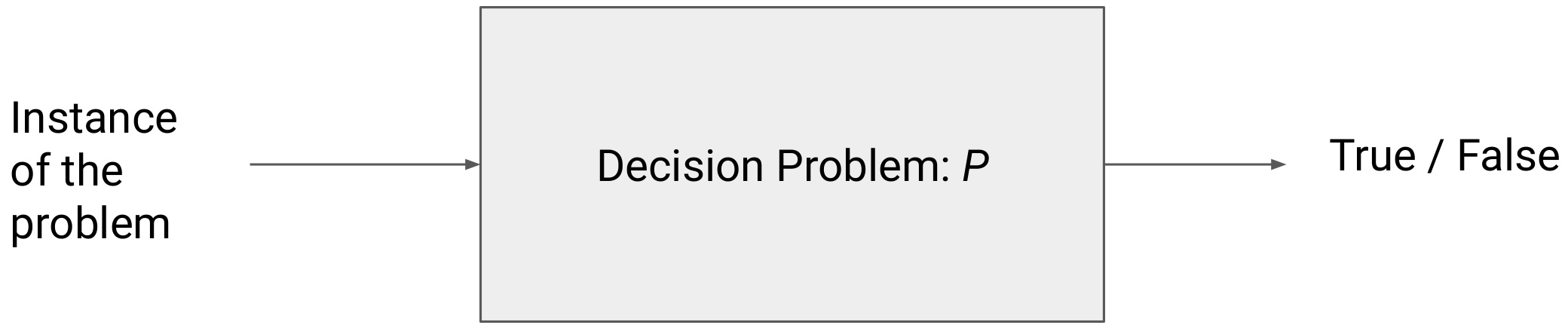
- an instance goes in
- a boolean value comes out
- \(P\) names the problem itself
The decision problem, as set membership
\[P(x) = (x \in B)\]
- \(A\): the set of all possible inputs
- \(B \subseteq A\): the set of desirable — “yes” — inputs
Reduces a problem’s definition to defining one set, \(B\).
Primality as a decision problem
- \(A\) = the set of all integers
- \(B\) = the set of all prime numbers
- \(P(n) = (n \in \text{Primes})\)
What decidable means, informally
Python decidability
A decision problem, \(P\), is decidable if it can be implemented in Python.
- Python stands in for any general-purpose language
- the program must halt on every instance
- the program must compute the correct boolean answer
Scope of the informal notion
Reaching a formal definition requires more machinery:
- mathematical logic
- a model of computation
PRIME, formalized in the next section, is decidable under this notion.
Formalizing a decision problem
Predicate logic over integers
Denoted \(L\):
- connectives: AND, OR, NOT
- quantifiers: \(\forall\) (for all), \(\exists\) (exists)
- variables ranging over the integers
- constants: \(0, 1, 2, \ldots\)
- integer addition and multiplication
Defining DIV
\[\text{DIV}(x, y) = \exists n.\ x = y \times n\]
\(x\) is divisible by \(y\): some integer \(n\) satisfies \(x = y \times n\).
Defining PRIME
\[\text{PRIME}(x) = \lnot\bigl(\exists y.\ \text{DIV}(x, y) \land \lnot(y = 1) \land \lnot(y = x)\bigr)\]
No \(y\), other than \(1\) or \(x\) itself, divides \(x\).
Checking the formalization
\[A = \mathbb{Z}, \quad B = \{\, x : \text{PRIME}(x) \,\}\]
The same decision problem stated informally earlier, now precise enough to check against its own definition.
The answer is no
The question, precisely
Are all decision problems expressible in \(L\) Python-decidable?
No.
Example 1: Gödel’s statement
- a numbering system assigning a unique integer to every logical statement
- a specific logical statement constructed about its own Gödel number
- no computation can ever determine whether that statement is true or false
Example 2: Diophantine equations
- a polynomial equation with integer coefficients
- the question: does an integer solution exist?
- no Python program solves all possible instances
Scope of the two examples
- neither example is proved here from first principles
- both are stated as results
- both are given at the level of detail the informal notion of decidability supports
What a real proof would require
Five open questions
- Why are these decision problems Python-undecidable?
- How is a Diophantine equation a decision problem?
- What if a programming language “better” than Python is used?
- Are there other undecidable problems?
- How does one solve an undecidable problem?
The language-dependence question
Question 3 exposes the gap directly.
- “Python decidable” is defined relative to one particular language
- the informal notion has no way to rule out another language succeeding where Python cannot
Requirement for a proof
Answering any of the five questions requires:
- replacing “can be implemented in Python” with a precise mathematical object standing in for algorithm
- a mathematical model of computation general enough that “no algorithm exists” can be checked, and the result applies to every programming language
Summary
Summary
- A decision problem is a boolean function, equivalently membership in a set
- “Python decidable” is a working definition, not a final one
- Formalizing PRIME makes it checkable against its own definition
- The Entscheidungsproblem’s answer is no — stated here, not proved
- Five open questions close the unit, naming what has not yet been justified
Where next
Basics of a Turing Machine, the next unit in this module.
- builds the precise model of algorithm this unit leaves undefined
- resolves the open questions this unit closes with