More on Functional Programming
Clojure
2026-08-20 10:45
Where we are
Back from macros
The previous unit changed the language.
This one goes back to using it —
and takes one idea much further than before.
Where this ends
By the end you will have built an object system in Clojure.
Private state. Message dispatch.
From nothing but closures.
Then we ask whether you should.
Higher-order functions in practice
Square everything
Cube everything
Identical except for one function call.
Abstract it
You have written map.
Then it breaks
cons wraps the recursion, so it is not in tail position.
recur cannot help.
Laziness fixes it
The recursive call waits until the next element is asked for.
Reducing
Same shape — differing only in how they combine.
compute-across
You have written reduce.
It does more than arithmetic
The accumulator is a vector, not a number.
Filtering
Identical to all-greater-than but for the comparison. Extract it:
You have written filter.
The whole unit in one sentence
Every one came from noticing that two functions differed in one place —
and making that place a parameter.
Partial application
The situation
Now you need California. Then New York. Then everywhere.
The naive route
Duplication, and a new function per jurisdiction.
A factory instead
Each result is an ordinary one-argument function.
What is really happening
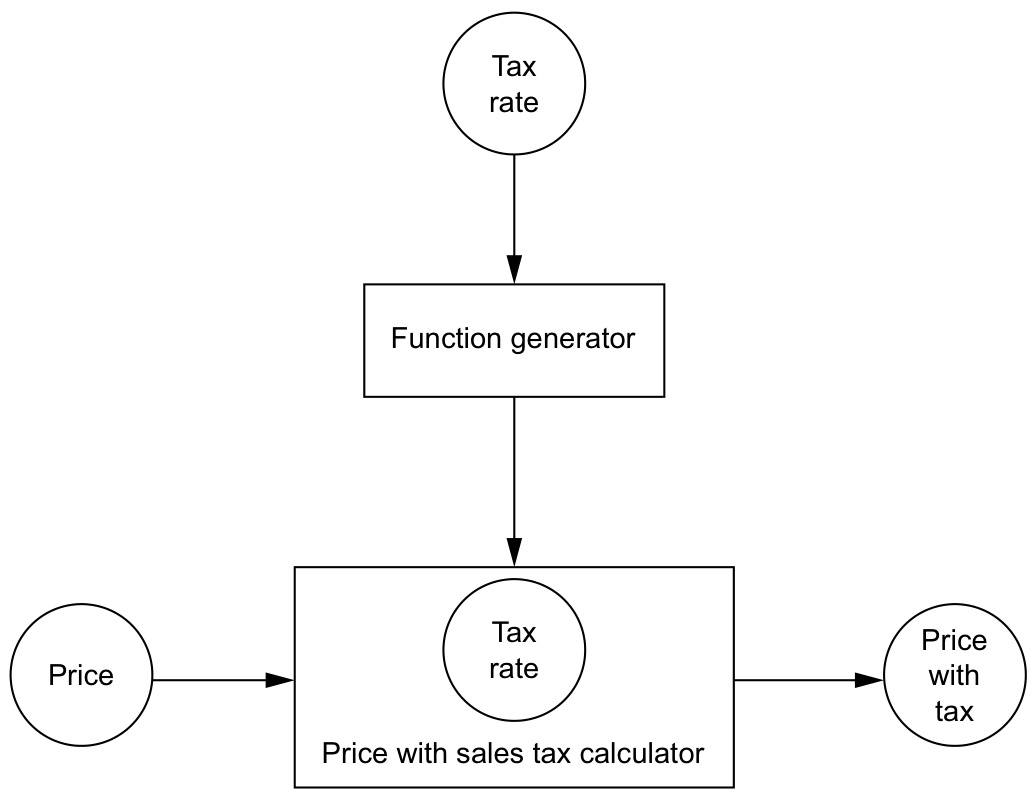
Adapting a general function by fixing its varying argument.
The returned function is a closure over state-tax.
Generalising
Clojure has this as partial, used identically.
Argument order is a design decision
The rule
You can only fix arguments from the left.
Put the parts that vary least first.
Which is why (map f coll) is ordered as it is.
Closures
Free variables
x is neither a parameter nor bound in the body. It is free.
Why “closure”
A function with free variables is open —
you cannot say what it computes without knowing those names.
Capturing them closes it.
Three things to notice
adderreturned long ago, andxis still there(adder 2 3)and(adder 10 20)are independentadd-5takes one argument, not three
Configured at creation, not parameterised at every call.
Delayed computation
Something that fails
Extract the pattern
What just happened
Wrapping in a function of no arguments postpones it.
A function can now receive unevaluated work —
otherwise the exclusive privilege of macros.
Exception handling has become a value.
Closure or macro?
Closure — the caller writes the wrapper. Visible at the call site. Result is a value.
Macro — rewrites code. Caller writes ordinary code. Not a value.
The trade is syntax versus composability.
Which to choose
unless had to be a macro — requiring #() everywhere would be intolerable,
and easy to forget.
Here, where the wrapper is a deliberate abstraction,
the extra #() buys you a value back.
Closures as objects
A closure that dispatches
Information hiding
The inner function can see password. Callers cannot.
Adding behaviour
Data or function?
Although
arjunis a function, semantically it looks and behaves like data.
State ✓ · Behaviour ✓
The object system
Built up with methods, state and inheritance: a little over 50 lines.
The old debate
Are objects a poor man’s closures, or is it the other way around?
Note how the 50 lines divide
Fewer than half manipulate functions.
The rest exist to make the syntax look a certain way.
The semantics would not change under a different syntax.
What you can now abstract
Should you use it?
in most cases, such artificial constructs are unnecessary in languages such as Clojure
Reason one: abstraction
You do not need objects for data abstraction.
Clojure’s core structures are immutable and thread safe —
no need for procedural abstractions wrapping their mutation.
Reason two: Perlis
it’s better to have 100 functions that operate on a single data structure instead of 10 functions that operate on 10 data structures
And a practical cost
creating an object system … raises a barrier of inoperability with other libraries that don’t know about it
A map is transparent, printable, comparable, serialisable.
A closure’s state is opaque.
So why build one?
Because the exercise establishes the equivalence.
Deciding to use maps because objects are unavailable is not a decision.
Deciding to use maps having built objects is.
Summary
The six things to carry away
- Every core sequence function comes from abstracting one difference.
- Laziness is what lets them survive a large input.
- Partial application is a closure; argument order decides if it is possible.
- A closure outlives its scope, and each gets its own capture.
- Closures give private state and message dispatch — which is to say, objects.
- Knowing you can build objects is what lets you choose not to.
Where next
More Macros and DSLs returns to the macro thread —
with the same shape of ambition.
Anaphoric macros · compile-time computation
macros that write macros · a domain-specific language
Clojure · More on Functional Programming