Evolving Clojure Through Macros
Clojure
2026-08-20 10:30
Where we are
A claim from unit 1
your entire Clojure program is a series of lists: the very source code of your program is interpreted by the Clojure compiler as lists
Unit 2 added: cond is a nested list of pairs, and generating a list is easy.
This unit collects on both
Everything so far has been about using a language.
This is about changing it.
The route
- The phases — and where a macro acts
- Why a function cannot do it — the
unlessexample - Templates — syntax quote, unquote, splicing, gensym
- Clojure’s own macros
- Your own — five of them
- Judgement — when, and what it costs
The phases
Four of them
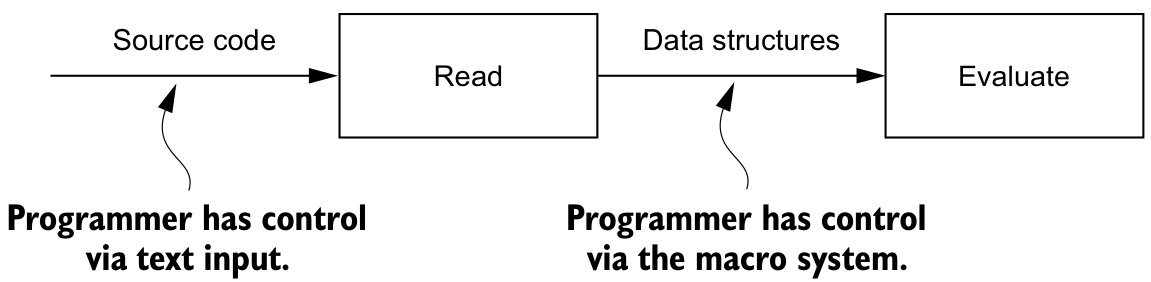
The phases of the Clojure runtime — the separation that makes macros possible.
What each does
Read — text becomes data structures. Reader macros act here.
Macroexpand — macros are called with unevaluated forms and return forms.
Compile — the result becomes bytecode.
Run — the bytecode executes.
Textual substitution
Look at what that body does
It is an ordinary function that builds a list.
The first element is the quoted symbol dosync.
That list is the code that will run.
Two consequences
Arguments are forms, not values.
(sync-set a-ref 1)hands the macro the symbola-ref, not the ref.
Macros have no runtime existence.
They cannot be passed to
map, stored, or called dynamically. They are not values.
Why unless cannot be a function
The goal
The attempt
Now an even number
It printed anyway.
Why
Clojure evaluates arguments before calling.
By the time unless receives then, the println has already run.
The function only sees the nil it left behind.
And the failure is quiet
Invisible when the body is pure.
Visible only when the body has a side effect or is expensive —
which is exactly when you care.
The workaround
Works — and every caller must remember the #().
Forget it once and the bug is back, silently.
The macro
The body was never evaluated. It was moved.
The three expansion tools
macroexpand-1— one stepmacroexpand— until the outermost form is not a macromacroexpand-all— everything, including nested
None of them run the result.
The general rule
A function receives values. A macro receives forms.
Must it decide whether to evaluate? Not a function.
Must it decide when, or how many times? Not a function.
Otherwise — use a function.
Templates and hygiene
Syntax quote
Two differences from ':
- symbols resolve to their namespaces
- the form becomes a template
Forget the unquote
user/then — the macro’s own parameter name, inserted literally.
Several body expressions
Printed both, then threw.
The expansion says why
Double parentheses. Both printlns evaluate to nil, giving (nil nil) —
an attempt to call nil as a function.
The fix
~ inserts the sequence. ~@ inserts its elements.
Variable capture
The error is protecting you
Suppose now were not qualified:
daily-report would see a number, not "2009-10-22".
The macro’s let captured the caller’s now.
Auto-gensym
now# might expand to now_14187_auto_.
Every occurrence in the template gets the same generated symbol.
Division of labour
Syntax quote’s namespace resolution → prevents capture of function names
Auto-gensym → prevents capture of local bindings
Clojure’s own macros
comment
The whole implementation. Returns nil.
Proof that arguments really are unevaluated — the body can be nonsense.
declare
Several forms from a variable number of arguments — that is ~@.
defonce
Cannot be a function: it must not evaluate expr when the name already exists.
and — the one worth reading
Three things at once
Short-circuits · recursive · gensym so x is evaluated once
And it explains why and returns the deciding value, not a boolean.
time
Must be a macro: it needs the form unevaluated in order to time evaluating it.
What the set teaches
Every technique from the previous section, in production code.
Each macro exists for a reason expressible in one sentence.
None of them is a macro for style.
Writing your own
infix
No evaluation control. No bindings. Purely rearranging.
A macro is, at bottom, a function from a list to a list.
randomly
Must be a macro — a function would evaluate all three.
defwebmethod: the problem
That destructuring preamble repeats in every handler.
defwebmethod: the macro
The shape behind every def-something in every library you will use.
defnn — keyword arguments
The macro computes part of the code, not merely templates it.
assert-true
The message quotes the source you wrote.
Only a macro can do this
A function receives only false, and can say nothing about where it came from.
Every testing library depends on this trick.
When not to write a macro
The rule
If a function can do it, use a function.
Macros are warranted when
- you must control whether or when something is evaluated
- you must introduce a binding the caller can see
- you must define a name
- you need the source form, not its value
What a macro costs
- not a value — cannot be passed to
map, stored, or composed - runs at a different time — errors surface as confusing expansions
- harder for a reader — they must know your macro first
The honest summary
Used well, a macro removes a repeated shape no function could abstract.
Used badly, it makes ordinary code unreadable for no gain.
Summary
The six things to carry away
- A macro runs between reading and compiling, on forms rather than values.
- Homoiconicity makes macros ordinary — there is no separate macro language.
unlesscannot be a function because arguments evaluate first.- Templates make macros writable; expansion makes them debuggable.
- Variable capture is silent, and auto-gensym prevents it.
- The judgement matters more than the mechanism.
Where next
More on Functional Programming sets macros aside.
Higher-order functions and closures, pushed until they become an object system.
And delayed evaluation from the other side — what a closure can do that a macro cannot.
Clojure · Evolving Clojure Through Macros