Clojure Elements: Data Structures and Functions
Clojure
2026-08-20 09:15
Where we are
Reading is not writing
Introducing Clojure taught you to read.
This unit gets you writing.
The longest, most reference-like unit in the module.
Type, do not read
Almost everything here is a form to try at the REPL.
The REPL is not an accessory to learning Clojure.
It is where the learning happens.
The four parts
- Coding at the REPL
- Data structures
- Program structure
- Program flow
By the end: the vocabulary to write small to medium programs.
Coding at the REPL
Hello, world — twice
Two lines. Why?
Evaluate, then print
println is side-effecting — it prints, then returns nil.
Hello, world! printed during the evaluation phase.
nil printed during the print phase.
The magic variables
*1,*2,*3— last, second-last, third-last successful form*e— the last error
Each success shifts the chain along.
Watch them shift
A subtlety
This captures the value that was in *1.
*1 moves on. a-str does not.
On error
The numbered variables stay put. Only *e changes.
Answer your own questions
doc— a function’s docstring and argument specfind-doc— search docstrings, when you do not know the nameapropos— search names
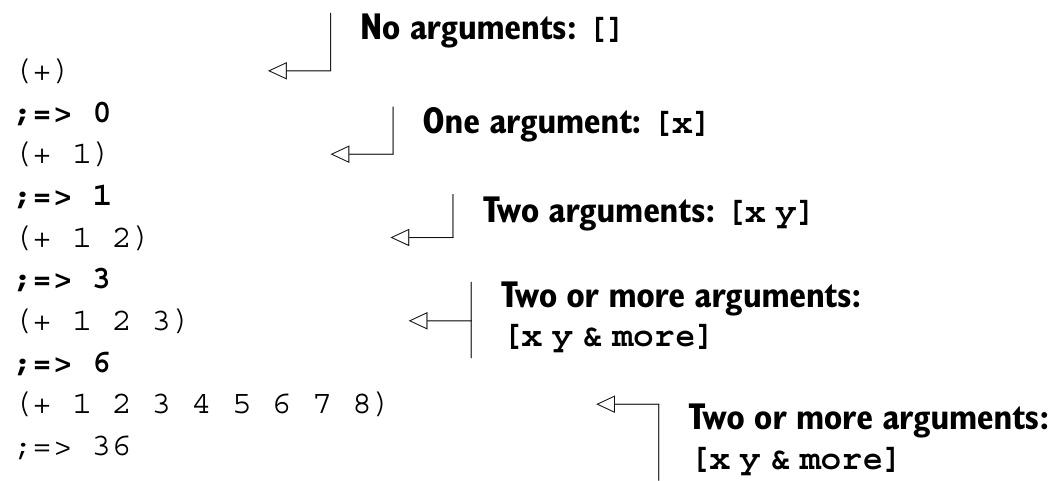
doc output for +.
Syntax revisited
You already write prefix notation
Function name first. Arguments after.
That is prefix notation.
Clojure just moves the parenthesis
And drops the comma — whitespace is enough.
Only the maths feels strange, because most languages special-case operators.
What regularity buys
it makes it easy to generate and manipulate code
cond is just a list
A nested list. An even number of expressions, in pairs.
Test, then result. Test, then result.
Compare
Generating that list: easy.
Generating a case statement in Java: not.
This is why the macro units later in this module are possible.
Commas are whitespace
The printer uses them when echoing maps — purely for your eyes.
Scalars and the number tower
Truthiness
Everything other than
falseandnilis considered true.
That is the whole rule.
Strings are Java strings
Both true. Note the leading periods — interop, from unit 1.
The number tower
| Type | Examples | Contagiousness |
|---|---|---|
| Integer | 42, 0x2a, 2r101010 |
0 |
| Big integer | 42N |
1 |
| Ratio | 1/3, -2/4 |
2 |
| Big decimal | 2.78M |
3 |
| Floating point | 2.78 |
4 |
(/ 4 9) gives the ratio 4/9.
Contagiousness in action
Overflow
+' -' *' inc' dec' — a trailing quote means autopromote.
Symbols and keywords
Symbols are identifiers
In (+ 1 2), the + is a symbol signifying the addition function.
Reading and evaluating are separate, so a symbol has two aspects:
its existence as data, and the value it resolves to.
Valid and invalid
valid — foo foo/bar ->Bar -foo foo? foo-bar foo+bar
invalid — /bar /foo +1foo
Quoting makes a symbol data
The quote says: this is literal data, not code.
Keywords are built for that
A keyword is sort of like an autoquoted symbol.
Never references another value. Always evaluates to itself.
:foo :foo/bar :->foo :+
Converting
No namespace part → nil. name leaves strings unchanged.
Lists, vectors and maps
Lists: front only
Singly linked. Add and remove at the front.
The payoff: multiple lists can share tails.
Lists as stacks
Lists are special
Fails. The compiler reads lists as code — it tries to call 1.
Vectors: indexed
Maps: two ways to look up
Both the map and the keyword are callable.
Maps: add and remove
New maps each time. Nothing was mutated.
Nested data
assoc-in creates missing intermediate maps.
update-in takes a function, not a value.
The sequence abstraction
Three functions
first · rest · cons
Every collection supports them.
Across collections
Two results to notice
A map seen as a sequence is a sequence of pairs.
Why this is the key section
map, filter, remove, reduce never need to know
whether they were handed a list, a vector, or a map.
One abstraction carries the whole module.
Structuring a program
defn is def plus fn
A function is a value bound to a name. Exactly as unit 1 promised.
let: before
let: after
Not shorter. Legible. That is the point.
Bindings are sequential
And bind to _ when you need the binding but not the value.
Where do is needed
if takes single expressions for its branches:
Function bodies and when already have an implicit do.
Conditionals and logic
Five forms, two axes
Negated? · Else branch and implicit do?
Choosing
if — has an alternative, takes single expressions
when — no alternative, but takes a body
So when saves you writing do.
and returns values
The last value if all truthy — otherwise the actual falsey value that stopped it.
or too
First truthy value, or the last falsey one.
This is what makes or usable for defaults.
Comparisons chain
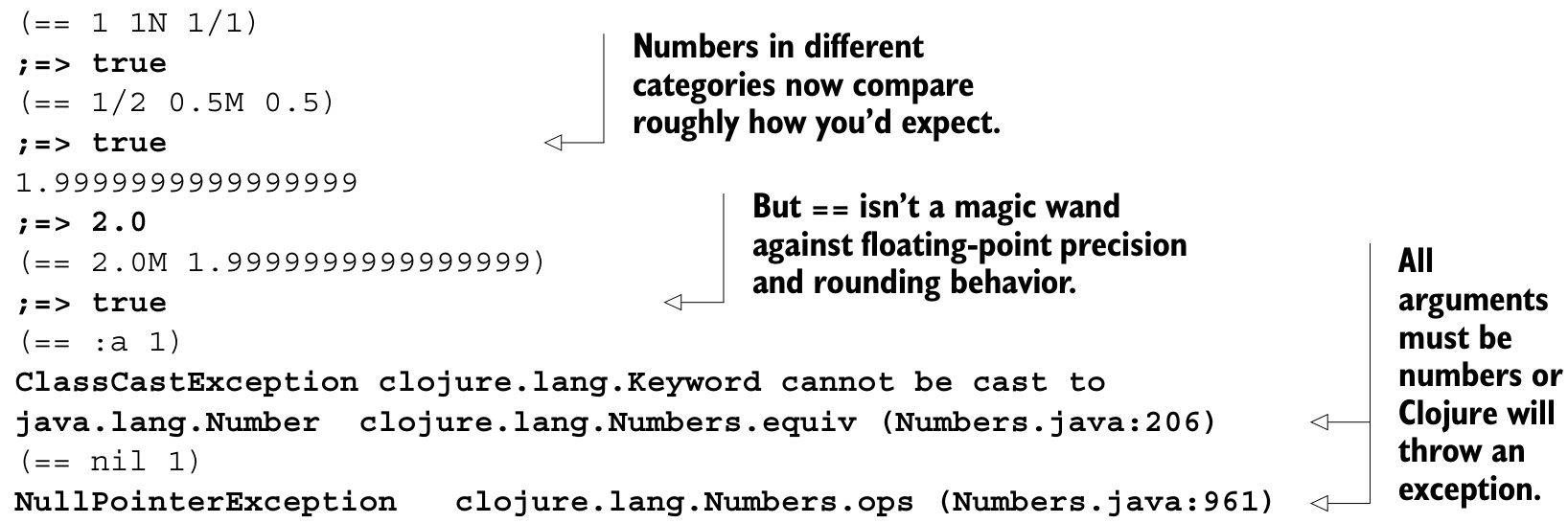
= versus == for numeric equality.
Functional iteration
The vocabulary
while— polling something outside your controlloop/recur— stack-safe recursiondoseq,dotimes— side effectsmap,filter,remove,reduce— transformationfor— list comprehension
loop / recur

factorial with loop/recur.
recur must be in tail position
The recur is not last. Compile-time error.
Which is the good outcome — the compiler catches it.
Side effects
Both return nil. That is the signal you called them for their effects.
map
Multiple sequences → multiple arguments. Result is as long as the shortest.
filter, then remove
Same result. No helper function at all.
reduce
for is not a loop
It builds a sequence. Multiple bindings nest.
for with :when
Threading macros
Inside-out
Correct — and read in reverse of the order things happen.
Top to bottom
Each result threads into the first argument of the next form.
Same answers
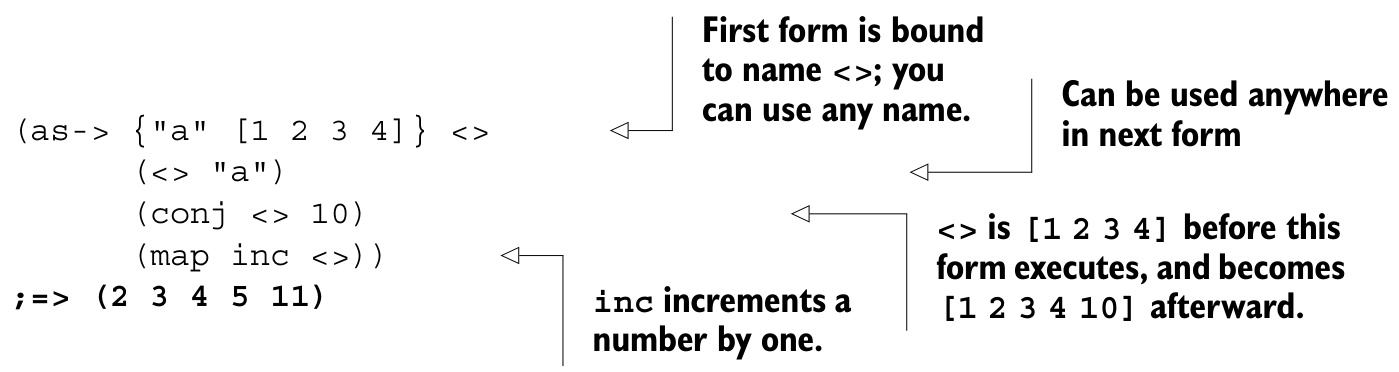
as->, for when the value does not belong in first position.
Notice what these are
They add no capability. They change legibility.
And they are macros — rewriting one expression shape into another before evaluation.
defn · when · cond · -> — you have used several already.
Summary
The through-line
The sequence abstraction.
Three functions in one short section are why map, filter, remove, reduce and for work on anything you hand them.
The six things to carry away
- The REPL is where the work happens; the magic variables and
docmake it explorable. - Prefix notation is regular, and regularity makes code generatable.
- Everything but
falseandnilis true; numbers form a tower with contagiousness. - Symbols resolve; keywords evaluate to themselves.
first,rest,consunify every collection.- Loops become a vocabulary —
recur, the sequence functions,for, then->.
Where next
Building Blocks of Clojure goes underneath all of this.
Higher-order functions · lexical closures · vars and binding
namespaces · destructuring · metadata and type hints
Clojure · Clojure Elements: Data Structures and Functions
Comments
One semicolon after code · two for a line · three for a block