More Macros and DSLs
Clojure
2026-08-20 11:00
Where we are
The same move, twice
Last unit: closures pushed until they became objects — then we chose not to use them.
This unit: macros pushed until they become languages.
From constructs to languages
The earlier macro unit added unless, randomly, assert-true.
This one:
- Anaphoric macros
- Compile-time computation
- Macro-generating macros
- Domain-specific languages
Where Lisp has always pointed
When a problem is awkward in your language —
build a better one for it.
A quick review
Compressed
- a macro runs at macroexpansion time
- arguments arrive as unevaluated forms
- the return value is a form
- templates use
`,~,~@ macroexpandshows what was producedname#prevents capture
This unit builds on all of it and re-derives none of it.
One rule we are about to break
The earlier unit taught that an un-gensymed binding is a bug.
Variable capture.
Hold onto that. The next section does it on purpose.
Anaphoric macros
An anaphor
A word referring back to something earlier.
take the report and file it
The problem
It runs twice.
The usual fixes
Better — but you invented a name and wrote it three times.
What we want
Implementing it
~'it inserts the unqualified symbol.
A bare it would become user/it and be useless.
Deliberately unhygienic.
It works
Generalise over the operator
The cost
The binding is invisible at the call site.
A reader who does not know the macro cannot tell where it came from.
And any it the caller already had is shadowed.
Threading in any position
Fixed positions
Where they fail
That #() exists only to move the value into the right slot.
Clojure’s answer: as->
Each step binds to result. Put it where it belongs.
The anaphoric version
Recursive expansion
Each step binds it and recurses — nested let forms.
Shifting computation to compile time
The cipher, without macros
(def ALPHABETS [\a \b \c ... \z])
(def NUM-ALPHABETS (count ALPHABETS))
(def INDICES (range 1 (inc NUM-ALPHABETS)))
(def lookup (zipmap INDICES ALPHABETS))

(defn shift [shift-by index]
  (let [shifted (+ (mod shift-by NUM-ALPHABETS) index)]
    (cond
      (<= shifted 0) (+ shifted NUM-ALPHABETS)
      (> shifted NUM-ALPHABETS) (- shifted NUM-ALPHABETS)
      :else shifted)))
The tableau
It is reciprocal
What is wasteful
shifted-tableau runs on every call —
though it depends only on a constant.
memoize helps, but it still runs at least once.
What we actually want
The table written into the code.
The macro
Computes the tableau during expansion and embeds the result.
The expansion
An inline literal map.
The flow
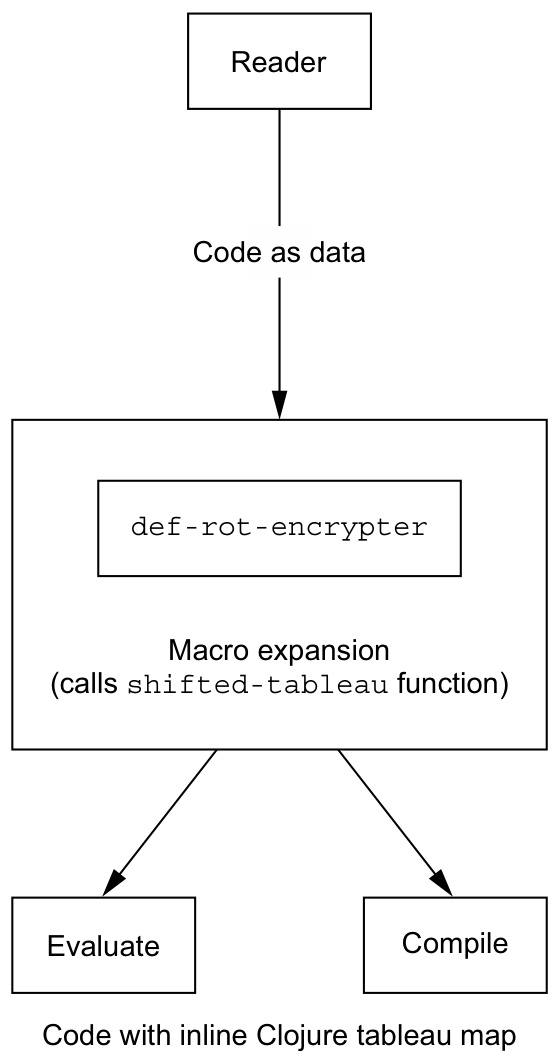
Macros expand during reading; the generated tableau lands in the source as a literal.
What that buys
the new
encrypt13function at runtime doesn’t do any tableau computation at all
Ship it as a library and users would never know shifted-tableau was called.
When it is worth doing
Work that is expensive, repeated, and determined by compile-time constants.
All three. And no function can do it, at any level of cleverness.
Macros that write macros
The premise
A macro returns code.
A defmacro is code.
So a macro can return a defmacro.
The goal
The template
Written by hand, b would be:
So make-synonym must produce exactly that.
The naive attempt
user/stuff and user/old-name. Both wrong.
What a nested backquote does
One backquote produces the form.
Two produce code that produces the form — hence all the concat and list.
The working version
That odd ~'~old-name
first,
~old-nameis expanded, leaving~'binding… Then the outer backquote is expanded, leaving'binding, which finally becomes(quote binding)
Needed so the value is not resolved until the generated macro expands.
How to write these
Not by reasoning about quote levels in your head.
Macroexpand one level at a time and compare against the hand-written template.
When it is warranted
Not for one macro. Write that macro.
It pays for a family of near-identical macros —
which is exactly what a DSL is.
Domain-specific languages
Two design considerations
Decomposition — top-down breaks the problem down; bottom-up builds vocabulary up.
Combinability — vocabulary you can combine covers cases you did not anticipate.
The problem
Segment users of a website by what they did.
Session persistence
(ns clj-in-act.ch11.session
  (:require redis))

(def redis-key-for :consumer-id)
(def ^:dynamic *session*)

(defn save-session [session]
  (redis/set (redis-key-for session) (pr-str session)))

(defn find-session [consumer-id]
  (read-string (redis/get consumer-id)))

(defmacro in-session [consumer-id & body]
  `(binding [*session* (find-session ~consumer-id)]
     (do ~@body)))
The language we want
Read those as a domain expert
They say what a segment is.
Not how to compute it.
No Redis. No sessions. No lookups.
How it is built
What had to be a macro
Only two things.
defsegment — it defines a name and must receive the rule unevaluated.
in-session — it establishes a binding around a body.
Everything else is ordinary functions and data.
The lesson
A DSL built mostly from macros is usually a DSL built wrong.
Metalinguistic abstraction
When a problem is awkward, build a better language for it.
Most languages do not offer this option.
Which makes the discipline of not doing it part of the skill.
What you can now build
Every technique has a cost
- an anaphoric macro introduces a binding from nowhere
- compile-time computation means the code that runs is not the code you wrote
- a macro-generating macro is hard to read even when correct
- a DSL must be learned before any program in it can be read
Against that
A good DSL makes the problem visible instead of the plumbing.
And lets people who understand the domain read and check the rules.
The test
Would a competent Clojure programmer, new to this codebase, be able to read it?
Easier because the domain vocabulary is clearer? Build it.
Harder because they must learn your language first? Write the functions.
Summary
The six things to carry away
- Anaphoric macros invert the hygiene rule on purpose.
thread-itthreads into any position, not only first or last.- Only a macro can move work to compile time.
- A macro can write a macro; the difficulty is entirely in the quoting.
- A good DSL is mostly functions and data.
- Metalinguistic abstraction is a real option and a real cost.
Where the module ends
From reading your first parenthesis —
to building languages.
The unifying fact
True since unit 1:
Your program is data, and you can compute with it.
Clojure · More Macros and DSLs